
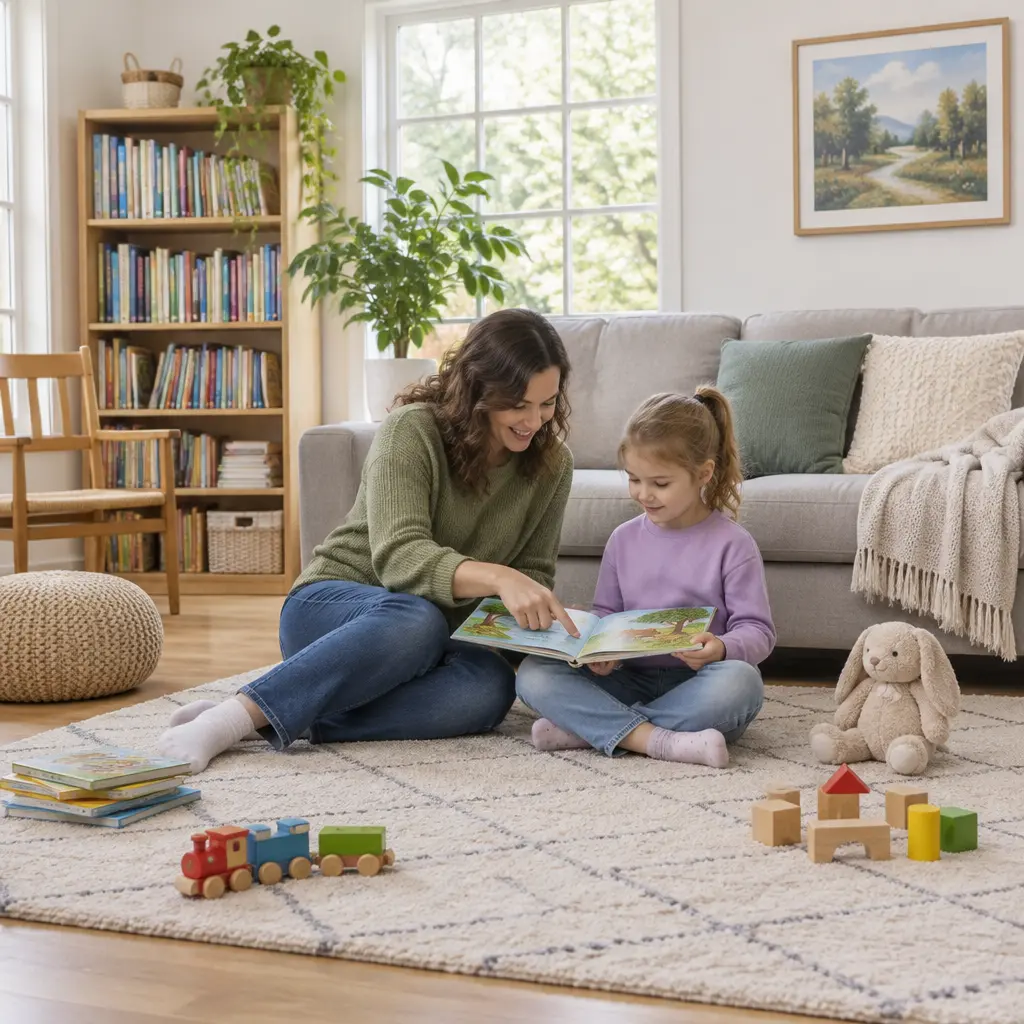
Effective home exercises for child language development are everyday, playful interactions that give children meaningful chances to understand and use words, gestures, and sentences. Families do not need special equipment: shared book reading, responsive conversation, songs, pretend play, and routines can all support communication when adults follow the child’s interests and respond warmly. Research reviews find that parent-implemented language interventions can improve children’s communication, while the U.S. Centers for Disease Control and Prevention (CDC) emphasizes talking, reading, and singing together as practical ways to support development. The sections below explain what makes home practice effective, how to adapt activities by age and skill, and how to monitor progress and seek professional guidance.
How effective home exercises support child language development
Home language exercises are intentional, everyday interactions in which caregivers help children notice, understand, and communicate meaning. The American Speech-Language-Hearing Association (ASHA) describes family involvement as an important part of speech and language support; useful strategies include following a child’s lead, responding to communication, and adding information to what the child says. These are not drills or a substitute for an individualized assessment. They make ordinary routines richer in language.
The World Health Organization’s 2018 Nurturing Care Framework identifies responsive caregiving and opportunities for early learning as essential components of children’s development. A 2011 meta-analysis by Megan Roberts and Ann Kaiser, published in the American Journal of Speech-Language Pathology, found positive effects of parent-implemented language interventions for young children with language impairments, while noting that outcomes varied by intervention and child. This evidence supports purposeful, responsive practice—not a promise that one activity works equally for every child.
The most useful home exercises share several features: they happen often in short, manageable moments; adults give children time to respond; and the interaction follows the child’s attention rather than testing performance. The related activity types—shared reading, conversation, play, songs, and daily routines—can be combined and adjusted to a child’s developmental level.
Responsive conversation and language modeling
Responsive conversation means noticing a child’s look, gesture, sound, or words and replying in a way that connects to what the child is communicating. If a child points to a cup, an adult might say, “You want your cup. Here’s the blue cup.” This acknowledges the message and supplies a slightly richer model without requiring the child to repeat it. ASHA’s public guidance for families recommends talking about what a child is doing and adding words to the child’s communication.
A practical technique is expansion: repeat the child’s meaning in a more complete form. If the child says, “Dog run,” the adult can respond, “Yes, the dog is running.” Pause afterward so the child can take another turn. These exchanges are useful for vocabulary, sentence structure, and conversational turn-taking. Adults should avoid turning every interaction into a quiz; a genuine comment or shared observation often keeps communication more natural.
Shared reading and picture talk
Shared reading is an interactive activity in which an adult and child look at a book together, talk about pictures, and connect the story with the child’s experiences. The adult can name an object, describe an action, or ask an open question such as, “What do you think the bear will do?” For younger children, pointing, labeling, and responding to sounds or gestures are meaningful participation; a child does not need to sit through an entire book or answer every question.
The American Academy of Pediatrics recommends shared reading beginning in infancy, and its policy on literacy promotion describes reading together as a way to support language and relationships. Families can reread a favorite book, pause to let the child complete a familiar phrase, or relate a picture to real life: “That’s a bus like the one we rode.” The goal is a warm exchange, not finishing pages quickly.
Play, pretend, and songs
Play-based language practice uses toys, pretend situations, movement, or music to make communication purposeful. During pretend cooking, for example, an adult can model words such as “stir,” “hot,” “more,” and “finished,” then wait for the child to gesture, vocalize, or speak. Songs and nursery rhymes add repetition, rhythm, and predictable pauses; adults can stop before a familiar word to invite a sound, gesture, or word from the child.
The CDC’s developmental guidance encourages families to read, sing, play, and talk with children. Repetition can help children anticipate what comes next, but participation should remain optional and enjoyable. Follow the child’s interests, use simple language that fits the moment, and treat gestures, facial expressions, and augmentative communication as valid ways to take a turn.
How to adapt home language exercises by age and communication skill
Children develop at different rates, so age ranges are guides rather than deadlines. The CDC’s milestone checklists describe skills that most children—at least 75%—can do by a given age. Milestones are not diagnostic tests, and a child’s overall communication should be considered across settings and languages. Adapt exercises to what the child can already do, then offer a small next step.
Babies and young toddlers: gestures, sounds, and first words
For babies and young toddlers, language practice includes looking, listening, babbling, gestures, and early words. Copy a baby’s sounds, name what captures the child’s attention, and pause during face-to-face play to leave room for a response. With a toddler, offer simple choices—“apple or banana?”—while showing both options, and respond to pointing or signs as communication. The CDC lists milestones such as waving “bye-bye” around one year and trying to say one or more words besides “mama” or “dada” by 18 months; these examples can help families discuss development, but should not be used alone to judge it.
Preschoolers: vocabulary, longer phrases, and storytelling
Preschool exercises can build descriptive vocabulary, sentence length, and the ability to tell about events. While dressing, describe attributes and actions: “The striped sock goes on your foot.” After an outing, invite the child to recall one part of the experience, offering a model or visual cue if needed. The CDC’s four-year milestone checklist includes saying sentences with four or more words and talking about something that happened during the day. These are broad developmental indicators, not targets that every child must meet on a particular date.
School-age children: explanations, narratives, and conversation
For school-age children, home practice can support explaining ideas, organizing stories, learning new vocabulary, and taking conversational turns. Ask the child to explain how to play a game, describe a science activity, or retell a story using a beginning, middle, and end. If the child struggles, model one part and collaborate rather than correcting every error. A teacher or speech-language pathologist can help tailor practice when language needs affect learning, friendships, or participation.
Multilingual children and children who communicate differently
Children can learn more than one language, and multilingualism does not itself cause a language disorder. ASHA advises families to use the languages they know best and most naturally; rich communication across a child’s languages supports connection and learning. A child may use words from more than one language in the same conversation, which is a normal feature of multilingual language use. When there are concerns, assessment should consider all languages the child uses, not only English.
Children who use sign, picture systems, speech-generating devices, or other augmentative and alternative communication (AAC) can take part in the same reading, play, and routine-based activities. Keep the child’s communication system available, model its use while speaking, and respond to the child’s message. The American Academy of Pediatrics and ASHA describe AAC as a means of supporting communication; families should consult the child’s clinical team for individualized guidance rather than withholding a system to encourage speech.
How families can make home practice consistent and useful
Effective practice is less about a rigid daily lesson than about repeated, enjoyable opportunities across the day. A short exchange at breakfast, a song during cleanup, and picture talk at bedtime can provide meaningful practice without adding a demanding schedule. The following approach keeps activities practical and responsive.
- Choose a routine the child already enjoys, such as snack time, bath time, or a favorite book.
- Use a few clear words or phrases connected to the child’s focus, then pause to allow a response.
- Accept communication in any form, including gaze, gesture, sound, signs, speech, or AAC.
- Build on the child’s attempt by acknowledging it and adding one useful word or idea.
- Stop or change activities if the child becomes tired or disengaged; positive interaction matters more than completing a set number of repetitions.
Families can keep a simple note of new communication—such as a new word, gesture, or successful turn in conversation—to share with a clinician or teacher. Such notes are observations, not a substitute for screening. The CDC recommends developmental monitoring and screening as part of routine care; its guidance states that standardized developmental screening is recommended at 9, 18, and 30 months, and whenever a parent or provider has a concern.
When home exercises are not enough
Home activities can enrich communication, but they cannot determine why a child has difficulty communicating or replace professional evaluation. Talk with the child’s pediatrician if development concerns you, if a child loses previously acquired skills, or if communication difficulties interfere with everyday participation. Ask about hearing assessment as well, because hearing differences can affect access to spoken language. A speech-language pathologist can evaluate communication and recommend strategies suited to the child and family.
The CDC advises families not to wait when they have concerns about development: discuss them with a health professional and ask about developmental screening. Early support can help families understand a child’s strengths and needs and identify useful next steps. Seeking guidance is appropriate even when a child is still within a broad milestone range.
Conclusion: make everyday interaction the foundation of language practice
Effective home exercises for child language development include responsive conversation, shared reading, play, songs, and language-rich routines. Their common elements are attention to the child’s interests, meaningful turns, a little more language than the child currently uses, and a supportive response to every communication attempt. Adapt activities to the child’s age, languages, abilities, and preferred communication methods; use developmental milestones as conversation prompts rather than diagnoses.
Start with one enjoyable routine today, make space for the child to communicate, and share any ongoing concerns with a pediatrician or speech-language pathologist. For further guidance, consult CDC milestone resources, ASHA’s family information, and the American Academy of Pediatrics’ literacy recommendations.
Sources: American Speech-Language-Hearing Association, “Communication Milestones: Birth to 1 Year” and “Learning More Than One Language,” https://www.asha.org/public/speech/development/communication-milestones/; American Speech-Language-Hearing Association, “Learning More Than One Language,” https://www.asha.org/public/speech/development/learning-more-than-one-language/; American Academy of Pediatrics, “Literacy Promotion: An Essential Component of Primary Care Pediatric Practice,” https://publications.aap.org/pediatrics/article/134/2/404/32948/Literacy-Promotion-An-Essential-Component-of; Centers for Disease Control and Prevention, “Act Early: Milestones,” https://www.cdc.gov/act-early/milestones/; Centers for Disease Control and Prevention, “Developmental Monitoring and Screening,” https://www.cdc.gov/act-early/about/developmental-monitoring-and-screening.html; Roberts, Megan Y. and Ann P. Kaiser, “The Effectiveness of Parent-Implemented Language Interventions: A Meta-Analysis,” American Journal of Speech-Language Pathology, 2011, https://pubs.asha.org/doi/10.1044/1058-0360%282011/10-0055%29; World Health Organization, UNICEF, and World Bank Group, Nurturing Care for Early Childhood Development: A Framework for Helping Children Survive and Thrive to Transform Health and Human Potential, 2018, https://www.who.int/publications/i/item/9789241514064.